Restoring the Roberto Burle Marx Gardens at UNESCO Headquarters, Paris


_Picasso.jpg)


Roberto Burle Marx Gardens at UNESCO
Headquarters, Paris

UNESCO Headquarters in Paris was conceived as a “living museum”, where architecture, art and landscape would form a single cultural experience. Designed by Marcel Breuer, Pier Luigi Nervi and Bernard Zehrfuss, the headquarters emerged from the work of an international committee that included Lucio Costa, Le Corbusier, Walter Gropius, Sven Markelius and Ernesto Rogers, and was inaugurated in 1958. Today, UNESCO Headquarters remains one of the twentieth century's most important architectural ensembles, bringing together works by many of the world's leading architects and artists.
The Art Collection
“Integral to this vision was the creation of a collection of modern art. Leading artists were invited to contribute works to UNESCO Headquarters, bringing painting, sculpture, ceramics and landscape into direct dialogue with its architecture. Among them were Pablo Picasso, Joan Miró and Josep Llorens Artigas, Alexander Calder, Henry Moore, Isamu Noguchi, Rufino Tamayo and Karel Appel. Roberto Burle Marx would later extend this dialogue into the landscape through the six sunken patios he designed for UNESCO between 1963 and 1964.”

.jpeg)


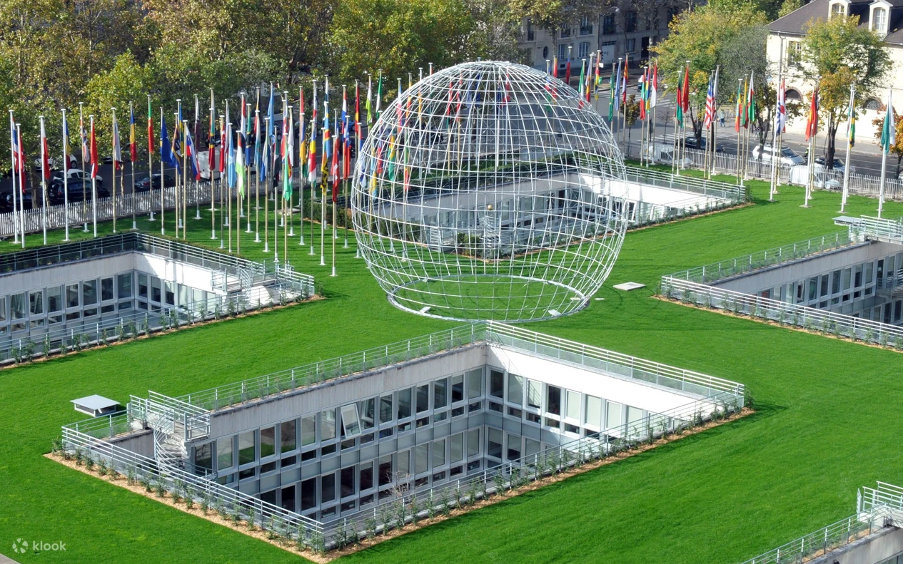
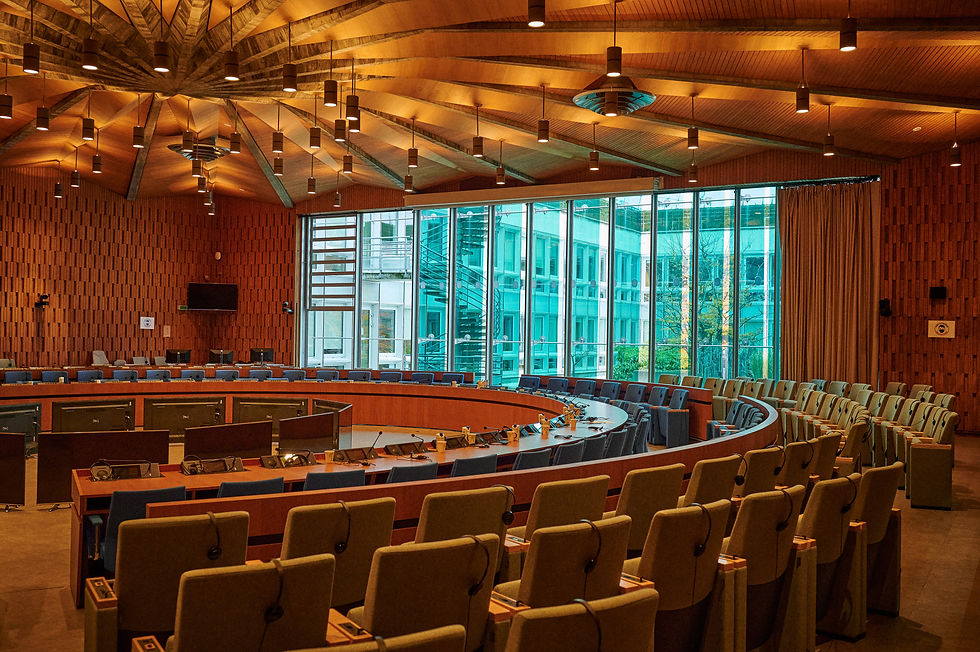
Between 1963 and 1964, Roberto Burle Marx designed six sunken patios for a new extension to UNESCO Headquarters, completed in 1965, creating a unified landscape composition across the complex and the Piazza facing the UNESCO Secretariat Building. The offices of UNESCO's 194 Permanent Delegations overlook Burle Marx's patios, as do Salle 10, one of UNESCO's principal conference halls, and the Salon des Délégués, the delegates' lounge. Every day, the gardens form part of the working environment of representatives from UNESCO's Member States. The continued presence of Burle Marx's gardens at the heart of UNESCO's daily life demonstrates that their significance extends far beyond their historical importance.
Gardens Beneath the Architecture
To expand office space without compromising the aesthetics of the Breuer, Nervi and Zehrfuss building, new offices were placed two floors below ground, organised around six courtyards. The composition commissioned from Burle Marx had a precise function: to bring natural light to these underground offices, built on a platform covering the parking areas and allowing only a shallow layer of topsoil. It was within this extreme constraint that he created one of his most poetic works.
The Original Designs
The original gouache studies show each of the six courtyards as its own composition, a painting seen from above. Built from a limited vocabulary of materials including gravel, cut stone, concrete, earth, grass and planting, the six compositions play off one another like movements in a single piece of music, retaining the simplicity Burle Marx always sought. Together, they reveal him thinking not only as a landscape architect, but also as a painter.

The Original Model
The original model provides a rare three-dimensional understanding of Burle Marx’s vision for the entire ensemble before decades of later alterations. It reveals the relationship between the six courtyards, the piazza and the surrounding architecture, creating moments of contemplation within the institutional rhythm of UNESCO.

Architectural model:
Original architectural model of UNESCO Headquarters in Paris, showing the relationship between the Secretariat Building, the Miollis Building and the future location of Roberto Burle Marx's gardens.

Historic photograph of UNESCO Headquarters:
UNESCO Headquarters shortly after its completion in Paris.

Historic photograph of the Piazza:
Roberto Burle Marx's Piazza shortly after its completion at UNESCO Headquarters.

Historic photograph of the six patios:
Roberto Burle Marx's six patios within the Miollis Building shortly after their completion.

The Courtyards
Reading the UNESCO Ensemble
Few scholars have contributed more to the understanding of Roberto Burle Marx's work than the art historian Jacques Leenhardt. Having known and interviewed the artist personally, he has devoted decades to interpreting his work. His essay on the UNESCO ensemble offers one of the most profound readings ever written of this remarkable work. Five ideas, in particular, illuminate the artistic vision behind the project, in Jacques Leenhardt's own words:
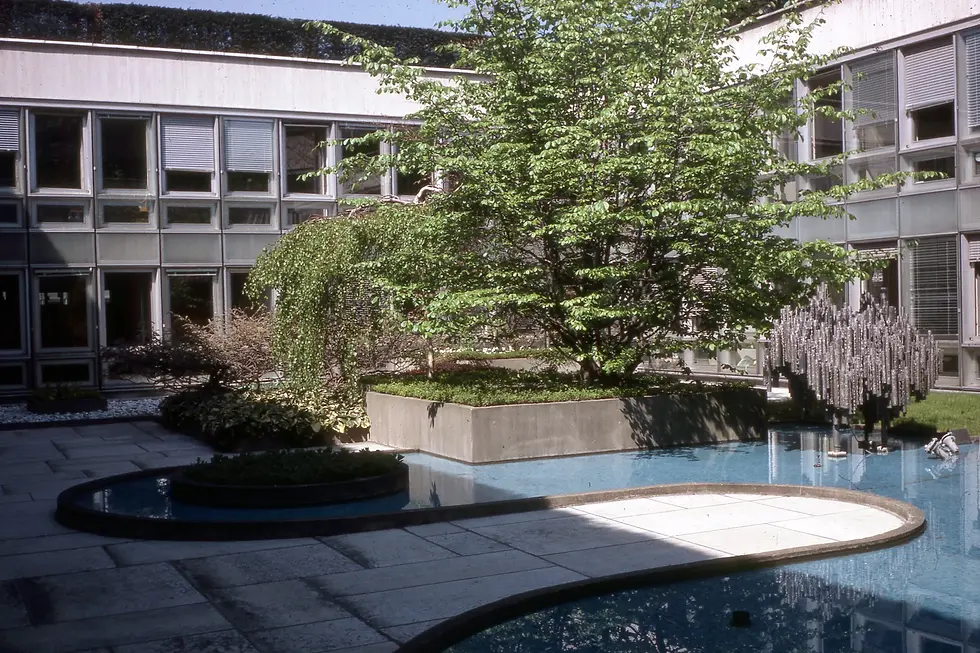
'The six patios are a type of enclosed, or "secret" garden, often associated with spaces dedicated to contemplation and reflection.'
'These enclosed gardens can be in dialogue only with the architecture.'
'They bring to architectonic rigidity two elements that it lacks: movement and colour.'
'By bringing the sky down to earth, the water’s surface in the pools opens up the confined space of the patios to light and verticality.'
'Restoring a garden never means copying a hypothetical original. It means recovering the spirit of the place.'
These excerpts are drawn from an essay by Jacques Leenhardt included within Roberto Burle Marx: A Journey with the Artist to UNESCO Patios in Paris, a 134-page dossier published by UNESCO in 2021.
"Read the essay: Roberto Burle Marx: a journey with the artist to UNESCO patios in Paris."
The photographs below show Roberto Burle Marx’s patios as originally conceived.



Current State and Restoration
Sixty years after their completion, the courtyards bear half a century of makeshift upkeep and invasive landscaping. The deterioration of the waterproofing system forced the water supply to the pools to be cut off, disfiguring the composition. The original piazza, of which only photographs remain, has disappeared entirely.
The Roberto Burle Marx Foundation is working in partnership with UNESCO to recover the artistic integrity of the original composition, while respecting the historical evolution of the site.
The Patios Today
In April 2026, Andrea Burle Webb, Founder and Chair of the Roberto Burle Marx Foundation, was granted access by UNESCO to inspect all six patios and the Piazza at UNESCO Headquarters in Paris.
The photographs below document the current condition of Roberto Burle Marx's six patios and the Piazza after decades without comprehensive conservation. Together, they provide a record of this remarkable work in preparation for its restoration.


More than sixty years after their creation, these extraordinary spaces continue to demonstrate Roberto Burle Marx’s unique ability to unite architecture, art and landscape. Restoring this ensemble is about more than preserving a historic work. It is about restoring an essential part of UNESCO's architectural legacy and cultural heritage.
UNESCO Headquarters and flags, Paris — © UNESCO.
UNESCO emblem at UNESCO Headquarters, Paris, 14 September 2011 — Photograph: Miguel Medina / AFP / Getty Images.
Flags at UNESCO Headquarters, Paris — Photograph: Christian Mueller / iStock.
UNESCO Headquarters, Paris — © UNESCO.
UNESCO Headquarters, Paris, aerial view — © UNESCO.
UNESCO Headquarters and flags, Paris — © UNESCO.
UNESCO Headquarters and illuminated Globe Symbol, Paris — © UNESCO.
Roberto Burle Marx tending flowers at his home © Burle Marx Landscape Design Studio, Rio de Janeiro.
The photographs used in galleries: 1, 3, 4, 5, 6 on this page are © Burle Marx Foundation Archives. All rights reserved.
Our Collaborators & Sponsors


