American Legacy


.jpg)


Roberto Burle Marx and American Modernism
'The real creator of the modern garden.'
— American Institute of Architects, 1965
Introduction
Throughout his career, Roberto Burle Marx maintained a remarkable dialogue with many of the leading architects, landscape architects and designers who shaped twentieth-century American modernism. Their correspondence reveals an international exchange of ideas across disciplines and national boundaries, placing Burle Marx at the centre of one of the most influential modernist networks of the twentieth century.
A Shared Modernist Vision
Roberto Burle Marx's relationships with leading architects, landscape architects and designers in the United States reflected a shared commitment to redefining the relationship between nature, architecture and the modern city. Although each developed a distinctive approach, they were united by a belief that landscape should play an essential role in shaping human experience.
For Roberto Burle Marx, correspondence was an essential instrument of professional exchange. Through letters, he discussed projects, shared ideas, maintained long-standing professional relationships and participated in an international dialogue on architecture, landscape architecture, urbanism and ecology. His correspondence reveals that he was not an isolated Brazilian designer, but an active participant in one of the twentieth century's most influential international networks of modern thought.
Today, these historic connections continue to demonstrate the international significance of Roberto Burle Marx's legacy and provide a strong foundation for the Foundation's collaborations with institutions, universities and cultural organisations across the United States.
A Network of Modernist Thinkers
Walter Gropius

Founder of the Bauhaus, Walter Gropius visited Brazil in January 1954 with his wife, the designer and writer Ise Frank, as a member of the jury for the II São Paulo Bienal's International Exhibition of Architecture. Roberto Burle Marx welcomed the couple to Rio de Janeiro and accompanied them on visits to several of his gardens, including the garden of Odette Monteiro, in Corrêas, Petrópolis. Their correspondence reveals a relationship of mutual intellectual respect and a shared concern for architecture, urbanism and the future of the natural environment.
'I entirely share your point of view on architecture, above all when referring to urbanism... It is very selfish to think only of the present, instead of thinking of the future.'
— Roberto Burle Marx to Walter Gropius, Rio de Janeiro, 2 April 1954.
Josep Lluís Sert

Catalan architect Josep Lluís Sert, who settled in the United States in 1939 and was appointed Dean of Harvard University's Graduate School of Design in 1953, first visited Brazil in January 1954 together with Walter Gropius for the II São Paulo Biennial's International Exhibition of Architecture. After returning to the United States, Sert invited Roberto Burle Marx to deliver a lecture at Harvard's Department of Landscape Architecture.
At the time, Burle Marx was simultaneously preparing his exhibition for the Smithsonian Institution in Washington, D.C., reflecting the growing international recognition of his work and the close professional relationship that developed between the two men.
'I've already prepared my speech for the lecture and feel greatly honoured by your invitation.'
— Roberto Burle Marx to Josep Lluís Sert, Rio de Janeiro, 28 April 1954.
Eero Saarinen
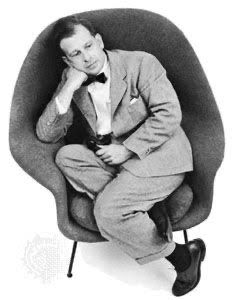
Finnish-American architect Eero Saarinen and his wife, the journalist and architecture critic Aline Bernstein Saarinen, welcomed Roberto Burle Marx to their home during his visit to the United States in 1954. Their correspondence reveals a friendship founded on mutual admiration, professional exchange and a shared belief that architecture must be experienced directly rather than understood only through photographs.
Burle Marx praised Saarinen’s architecture for its honesty, proportion and attention to detail, while expressing his wish to collaborate on one of Saarinen’s future projects. The correspondence also reflects the growing international recognition of Burle Marx’s work following his exhibition in Washington and Aline Saarinen’s article in The New York Times.
'One can’t judge, can one, from architectural photos or even slides, so that when one can study the work in situ, one’s emotion is a hundred times greater, and the impact is direct.'
— Roberto Burle Marx to Eero and Aline Saarinen, Rio de Janeiro, 20 August 1954.
Richard Neutra

Austrian-born American architect Richard Neutra and Roberto Burle Marx developed a professional relationship that resulted in two significant collaborations: the gardens for the Alfred de Schulthess Residence near Havana, Cuba, and a mural for the Amalgamated Clothing Workers of America building in Los Angeles. Their correspondence reveals not only mutual admiration, but also an active exchange of ideas and projects between two of the leading figures of twentieth-century modern architecture and landscape design.
Burle Marx also reflects on the nature of tropical gardens, observing that their full expression can only be appreciated over time as trees and palms mature, a perspective that reflects his long-term vision of landscape design.
'I know that a garden only begins to take on the right expression a few years after its planting, principally because of the development of the larger volumes such as trees, palms etc.'
— Roberto Burle Marx to Richard Neutra, Rio de Janeiro, 11 May 1957.

Burle Marx panel for the hall of the Amalgamated Clothing Workers of America, designed by Richard Neutra, Los Angeles. Image: Burle Marx Landscape Architecture Office Archive.
Ian McHarg

Scottish landscape architect Ian McHarg, founder of the Department of Landscape Architecture at the University of Pennsylvania and later author of the influential book Design with Nature, invited Roberto Burle Marx to contribute material on his work to a research project then underway.
In response, Burle Marx offered to send documentation of several recent projects, including the Parque del Este in Caracas and the landscape design for the Faculty of Architecture at the Federal University of Rio de Janeiro, together with other completed gardens. The correspondence reflects his willingness to contribute to the international exchange of knowledge in landscape architecture.
'I am very interested in the outcome of your project and hope that my contribution will aid its success.'
— Roberto Burle Marx to Ian McHarg, Rio de Janeiro, 8 June 1961.

Thomas Church

One of the leading figures of modern American landscape architecture, Thomas Church was instrumental in redefining twentieth-century landscape design by promoting a more natural relationship between architecture, gardens and everyday life.
His correspondence with Roberto Burle Marx began in the late 1940s. In 1948, Church invited Burle Marx to contribute drawings and photographs to a landscape architecture exhibition organised by the California Association of Landscape Architects and the San Francisco Museum of Modern Art. Unfortunately, the invitation never reached Burle Marx, who believed it had been lost within Brazil's Ministry of Education.
Writing from Rio de Janeiro on 5 March 1949, Burle Marx explained the misunderstanding, expressed his enthusiasm for future collaboration, and described several projects then occupying his attention. Among them was his collaboration with Oscar Niemeyer on the Burton Tremaine House in Santa Barbara, California, commissioned by the American collector Burton Tremaine.
Although never built, the project's presentation drawings and model were later donated to the Museum of Modern Art (MoMA), New York, where they remain in the museum's permanent collection.
The letter also illustrates the breadth of Burle Marx's international professional relationships. He mentions preparing an exhibition in São Paulo and sending photographs to Harvard University and to fellow landscape architect Garrett Eckbo, reflecting the increasing recognition of his work in the United States.
'It would have been of the greatest interest to me to collaborate with such a distinguished and alive association as yours.'
— Roberto Burle Marx to Thomas Church, Rio de Janeiro, 5 March 1949.

Roberto Burle Marx, Garden Design for Beach House for Mr. and Mrs. Burton Tremaine, project, Santa Barbara, California (Site plan), 1948. Collection of The Museum of Modern Art (MoMA), New York.
Garrett Eckbo

American landscape architect Garrett Eckbo was one of the leading pioneers of modern landscape architecture in the United States. His correspondence with Roberto Burle Marx reveals a relationship based on mutual respect, intellectual exchange and a shared belief that landscape architecture should respond to the way people inhabit space. Eckbo introduced Burle Marx’s work to an American audience through his influential publications and later welcomed him during his visit to Los Angeles in 1954.
Burle Marx admired Eckbo’s vision of the modern garden as a place where architecture, landscape and everyday life formed a coherent whole. Their correspondence documents an exchange of ideas that helped shape the international dialogue on modern landscape architecture.
“It is especially interesting for me to study work like yours, where you are concerned with creating a place in which Man is identified not only with the landscape, but also situated in his relation with Space.”
— Roberto Burle Marx to Garrett Eckbo, Rio de Janeiro, 18 August 1954.
Lawrence Halprin

A graduate of Harvard's Graduate School of Design, where he studied alongside I. M. Pei and Philip Johnson, Lawrence Halprin began his career working with Thomas Church before establishing his own practice in San Francisco in 1949. He later became one of the leading figures of the second generation of modern American landscape architects.
Following his 1954 visit to the United States, Roberto Burle Marx wrote to Halprin to express his gratitude for the warm welcome he and his wife had extended. Reflecting on their meeting, Burle Marx attributed the immediate bond they had formed to their shared affinity for the arts and mutual understanding.
'Your welcome was so warm that I felt I had known you for many years. I believe that this is due at least in part to our affinity in the arts and our mutual understanding.'
— Roberto Burle Marx to Lawrence Halprin, Rio de Janeiro, 18 August 1954.
Source: Guilherme Mazza Dourado (ed.), Folhas em Movimento: Cartas de Burle Marx. São Paulo: Luste, 2022. Translation: Peter Musson.
Roberto Burle Marx in His Own Words


Roberto Burle Marx Lectures: Landscape as Art and Urbanism
Roberto Burle Marx Lectures: Landscape as Art and Urbanism, edited by Gareth Doherty and published by Lars Müller Publishers, brings together twelve lectures delivered by Burle Marx between 1954 and 1986, most of which had never previously been published in English. His lectures were presented at institutions and events internationally, including Harvard University, the Massachusetts Institute of Technology (MIT), the University of Georgia, Iowa State University and the annual conferences of the American Society of Landscape Architects (ASLA). Together, they offer direct insight into Burle Marx’s thinking on landscape, art, ecology, plants and the modern city.
His wider lecture activity in the United States extended beyond those documented in the volume. In May 1965, Burle Marx told The New Yorker: ‘I’m here to give some lectures at Yale and on the West Coast.’
Roberto Burle Marx at the ASLA Annual Meeting, 1985
In 1985, Roberto Burle Marx received the ASLA Medal, the highest honour awarded by the American Society of Landscape Architects, recognising his outstanding contribution to landscape architecture. During the same Annual Meeting, he delivered a special presentation that remains one of the most significant records of his reflections on landscape, art and urbanism.
A 1954 Touring Exhibition


In May 1954, the Pan American Union in Washington, D.C. presented Landscape Architecture in Brazil: Roberto Burle Marx, his first solo exhibition in the United States. Sponsored by the Smithsonian Institution Traveling Exhibition Service, the exhibition featured twenty-seven landscape projects through drawings and large-scale photographs. It subsequently travelled to:
-
Cranbrook Academy of Art, Bloomfield Hills, Michigan
-
Dallas Museum of Fine Arts (now the Dallas Museum of Art), Dallas
-
University of Illinois
-
Smith College Museum of Art, Northampton, Massachusetts
-
Georgia Institute of Technology, Atlanta
-
Pratt Institute School of Architecture, New York
-
Institute of Contemporary Arts, Boston (now the Institute of Contemporary Art/Boston)
-
J. B. Speed Art Museum, Louisville
-
University of Pennsylvania School of Fine Arts (now the Stuart Weitzman School of Design), Philadelphia
1991 — The Museum of Modern Art


Roberto Burle Marx: The Unnatural Art of the Garden, on view from 23 May to 13 August 1991, was described by MoMA as ‘the Museum’s first exhibition devoted to a landscape architect’. Spanning Burle Marx’s sixty-year career, the exhibition was organised by guest curator William Howard Adams in collaboration with the Museum’s Department of Architecture and Design, directed by Stuart Wrede. It was made possible by Banco Safra of Brazil, with additional support from Mr and Mrs Gustavo Cisneros.
Andrea Burle Webb, now Founder and Chair of The Roberto Burle Marx Foundation, worked closely with Adams and Burle Marx during the preparation of the exhibition and the selection of works presented at MoMA. In his catalogue essay, Adams situated Burle Marx within the wider history of twentieth-century modernism, tracing connections with figures including Walter Gropius and Richard Neutra, while recognising an ecological dimension to his work that anticipated by decades environmental concerns now central to contemporary landscape practice.
‘A garden is the result of an arrangement of natural materials according to aesthetic laws; interwoven throughout are the artist’s outlook on life, his past experiences, his affections, his attempts, his mistakes, and his successes.’
— Roberto Burle Marx
2016 — The Jewish Museum, New York


Roberto Burle Marx: Brazilian Modernist, on view from 6 May to 18 September 2016, was Burle Marx’s first major solo presentation in the United States since The Museum of Modern Art’s 1991 retrospective, twenty-five years earlier. Organised by Jens Hoffmann and Claudia J. Nahson, the exhibition brought together the many dimensions of his practice, including landscape, painting, drawing, sculpture, jewellery and stage design, revealing a body of work that, in the curators’ words, ‘defies categorisation’. The accompanying catalogue was published by The Jewish Museum and Yale University Press.
Alongside the historical material, the exhibition included newly commissioned works by contemporary artists responding to Burle Marx’s legacy, among them a site-specific installation by Brazilian artist Beatriz Milhazes in the Museum’s lobby. The exhibition was made possible by Deutsche Bank, with additional support from the Emanuel and Riane Gruss Charitable Foundation, the Graham Foundation for Advanced Studies in the Fine Arts, and the Consulate General of Brazil in New York. It later travelled to the Deutsche Bank KunstHalle in Berlin, where it was presented from July to October 2017.
‘My two professions complement each other.’
— Roberto Burle Marx
2019 — New York Botanical Garden


Brazilian Modern: The Living Art of Roberto Burle Marx, on view from 8 June to 29 September 2019, was the largest botanical exhibition NYBG had ever staged, and the first to combine a horticultural tribute to Burle Marx’s garden designs with a gallery exhibition of his paintings, drawings, prints and textiles. Organised by guest curator Edward J. Sullivan, with Raymond Jungles, FASLA, as guest designer and Francisca Coelho as planting designer, the exhibition presented Burle Marx not only as a pioneering landscape designer, but as a major figure of Brazilian modernism whose work across landscape, painting, drawing, printmaking and tapestry formed an interconnected creative practice. Sullivan explored this multidisciplinary vision through the idea of Burle Marx as a ‘total work of art’, placing his landscapes within the much broader artistic, botanical and cultural world that shaped his life and work.
At the heart of the exhibition was a new garden designed by Raymond Jungles, who had met Burle Marx in Miami in his mid-twenties and remained close to him, in both Florida and Rio, during the last twelve years of the artist’s life. Profoundly influenced by Burle Marx’s ecological and botanical principles, Jungles drew the NYBG garden’s circulation and planting from his mentor’s example, with a wall inspired by Burle Marx’s 1983 interior for the Banco Safra headquarters in São Paulo.
The exhibition was made possible by the LuEsther T. Mertz Charitable Trust, with major support from Bloomberg Philanthropies, J. Barclay Collins II, the Estate of Enid A. Haupt, the Melville Foundation, MetLife Foundation, Tom and Janet Montag, the National Endowment for the Humanities, Natura, Mrs. Arthur Ross, Carmen and John Thain, and the Consulate General of Brazil in New York, among others.
As Jungles recalled, Burle Marx often told him:
‘I design with principles, not formulas.’
— Roberto Burle Marx, as recalled by Raymond Jungles
Experience Burle Marx at Longwood Gardens
Longwood Gardens is home to the only intact garden in North America designed by Roberto Burle Marx. This short documentary offers a behind-the-scenes look at the Cascade Garden and the ongoing conservation of one of his most significant works outside Brazil.


The Greensfelder Award


Roberto Burle Marx received the Greensfelder Award from the Missouri Botanical Garden, recognising significant contributions to the planning and design of landscapes, gardens and parks for the improvement of the urban environment.
Continuing the Dialogue
Today, the Roberto Burle Marx Foundation continues this international dialogue through collaborations with leading universities, museums, cultural organisations and public institutions across the United States. These partnerships build upon the relationships established by Roberto Burle Marx himself and seek to advance research, conservation, education and international collaboration inspired by his legacy.
Support the Foundation
Help us continue Roberto Burle Marx's international legacy through research, conservation, exhibitions, education and major restoration projects.
Support the Foundation
Acknowledgements and Sources
Selected quotations reproduced on this page are taken from Folhas em Movimento: Cartas de Burle Marx.
Additional archival and bibliographical sources will be acknowledged where applicable.
Cascade Garden, Longwood Gardens, Pennsylvania | Image source: WEISS/MANFREDI. [PHOTOGRAPHER NOT IDENTIFIED].
Museum of Modern Art (MoMA), New York | [PHOTO CREDIT MISSING].
Brazilian Modern: The Living Art of Roberto Burle Marx, New York Botanical Garden, New York | Photo © Andrea Burle Webb, Burle Marx Foundation Archives. All rights reserved.
Smithsonian Institution Building, Washington, D.C. | Photo © Nate Lee, CC BY-SA 4.0.
The Jewish Museum, New York | Photo © Ajay Suresh, CC BY 2.0.
Embassy of Brazil, Washington, D.C. | Image source: Wikimapia.
Burle Marx Garden at the Embassy of Brazil, Washington, D.C. | Image source: Wikimapia.
Roberto Burle Marx at the Cascade Garden, Longwood Gardens | Photo © Larry Albee.
Biscayne Boulevard, Miami | Image © Burle Marx Landscape Design Studio, Rio de Janeiro.
Walter Gropius, 1958 | Photo © Philippe Halsman/Magnum Photos.
Josep Lluís Sert | Photo © Fundació Joan Miró / Arxiu Josep Lluís Sert.
Eero Saarinen seated in a Womb Chair, 1948 | Photo by Arnold Newman.
Richard Neutra, Los Angeles, 1950 | Photo © Julius Shulman.
Ian L. McHarg | Image © Architectural Archives, Stuart Weitzman School of Design, University of Pennsylvania.
Thomas Dolliver Church | Photo by Lawrence Halprin.
Garrett Eckbo | Photographer unknown. Image © Garrett Eckbo Collection, Environmental Design Archives, University of California, Berkeley.
Lawrence Halprin | Photographer unknown. Image source: Landscape Architect + Designer Profiles (ladprofile.weebly.com).
Roberto Burle Marx Lectures: Landscape as Art and Urbanism, edited by Gareth Doherty, Lars Müller Publishers, 2018.
Roberto Burle Marx addressing the American Society of Landscape Architects (ASLA), 1985 | Photo © Burle Marx & Cia. Ltda., Rio de Janeiro.
Opening of Roberto Burle Marx’s exhibition in Washington, 1954. José Gómez Sicre, Érico Veríssimo, Roberto Burle Marx and Walter Burle Marx | Image source: MASP Documentation Centre. Photographer unidentified.
Landscape Architecture in Brazil: Roberto Burle Marx, Washington, 18 May 1954. Fernando Lobo, Roberto Burle Marx, Mildred Bliss and Robert Woods Bliss | Image source: MASP Documentation Centre. Photographer unidentified
Roberto Burle Marx: The Unnatural Art of the Garden, by William Howard Adams, The Museum of Modern Art, New York, 1991. Book cover.
Roberto Burle Marx and William Howard Adams at the opening of the 1991 New York exhibition | Photo: Star Black. Roberto Burle Marx Institute, Rio de Janeiro. Reproduced from Folhas em Movimento: Cartas de Burle Marx, ed. Guilherme Mazza Dourado, p. 311.
Andrea Burle Dubeux Webb and Ronald Springer at the opening of Roberto Burle Marx: The Unnatural Art of the Garden, The Museum of Modern Art, New York, 1991. Photographer unknown. The Roberto Burle Marx Foundation Collection.
Installation view of Roberto Burle Marx: The Unnatural Art of the Garden, The Museum of Modern Art, New York, 1991 | Image source: Photographic Archive, The Museum of Modern Art Archives, New York.
Installation view of Roberto Burle Marx: The Unnatural Art of the Garden, The Museum of Modern Art, New York, 1991 | Image source: Photographic Archive, The Museum of Modern Art Archives, New York.
Installation view of Roberto Burle Marx: The Unnatural Art of the Garden, The Museum of Modern Art, New York, 1991 | Image source: Photographic Archive, The Museum of Modern Art Archives, New York.
Installation view of Roberto Burle Marx: The Unnatural Art of the Garden, The Museum of Modern Art, New York, 1991 | Image source: Photographic Archive, The Museum of Modern Art Archives, New York.
Roberto Burle Marx: Brazilian Modernist, The Jewish Museum and Yale University Press, 2016. © The Jewish Museum, New York.
Installation view of Roberto Burle Marx: Brazilian Modernist, The Jewish Museum, New York, 2016. Photo: David Heald.
Installation view of Roberto Burle Marx: Brazilian Modernist, The Jewish Museum, New York, 2016. Photo: David Heald.
Installation view of Roberto Burle Marx: Brazilian Modernist, The Jewish Museum, New York, 2016. Photo: David Heald.
Brazilian Modern: The Living Art of Roberto Burle Marx, exhibition catalogue, edited by Edward J. Sullivan and Joanna L. Groarke. New York Botanical Garden, 2019.
Brazilian Modern: The Living Art of Roberto Burle Marx, The New York Botanical Garden, 2019. Image: Raymond Jungles, Inc.
New York Botanical Garden, Brazilian Modern: The Living Art of Roberto Burle Marx, 2019. Photo: Frida Sternberg.
Brazilian Modern: The Living Art of Roberto Burle Marx, The New York Botanical Garden, 2019. Image source: Welcome2TheBronx.
Brazilian Modern: The Living Art of Roberto Burle Marx, The New York Botanical Garden, 2019. Image source: Welcome2TheBronx.
The Cascade Garden - Longwood
Cascade Garden, Longwood Gardens, designed by Roberto Burle Marx. Photo: Becca Mathias, 2021.
Image source: Longwood Gardens.
Hohenbergia correia-araujoi, Cascade Garden, Longwood Gardens. Photo: Laurie Carrozzino.
Image source: Longwood Gardens.
Nymphaea ‘Ring of Fire’, Waterlily Court, Longwood Gardens. Photo: Meghan Siano.
Nymphaea ‘Pixie Dust’, Waterlily Court, Longwood Gardens. Photo: Meghan Siano.
Cascade Garden, Longwood Gardens, designed by Roberto Burle Marx. Image source: Longwood Gardens.
Nymphaea ‘Ring of Fire’, Waterlily Court, Longwood Gardens. Photo: Meghan Siano.
Nymphaea ‘Liana’, Waterlily Court, Longwood Gardens. Photo: Meghan Siano.
Nymphaea ‘Siam Orchid’, Waterlily Court, Longwood Gardens. Photo: Meghan Siano.
Climatron, Missouri Botanical Garden, St. Louis. Image source: GardensOnline.
Climatron, Missouri Botanical Garden, St. Louis. Photos: Mary Lou Olson and Nathan Kwarta. Image source: Missouri Botanical Garden.
Our Collaborators & Sponsors


